

Reviews
Part of How to read marketing automation reviews: sources, red flags and a buyer test
The marketing automation selection checklist that tests the actual work before contract
Use a marketing automation selection checklist to verify buyer needs, product evidence, UK data controls, accessibility, contracts, testing and exit.
Use this marketing automation selection checklist to block unsupported assumptions before purchase.
What to take away
- The checklist blocks unsupported assumptions before purchase and is not an endorsement or performance promise.
- Every candidate must face the same scenario, data description and expected outputs before scoring.
- Roadmap, preview and generally available functions must be recorded separately from current features.
- Reopen selection when a mandatory feature, price unit, subprocessor, data location, support route or buyer purpose changes.
Method and scope
The checklist was compiled on 5 September 2026 for organisations operating in England. Items were included when they could change product admission, testing, contracting or exit. It excludes product rankings, price estimates, generic feature counts and supplier outcomes. The sequence is unranked and follows the buying process.
No account, product or service was tested, and there are no commercial conflicts.
Define the work
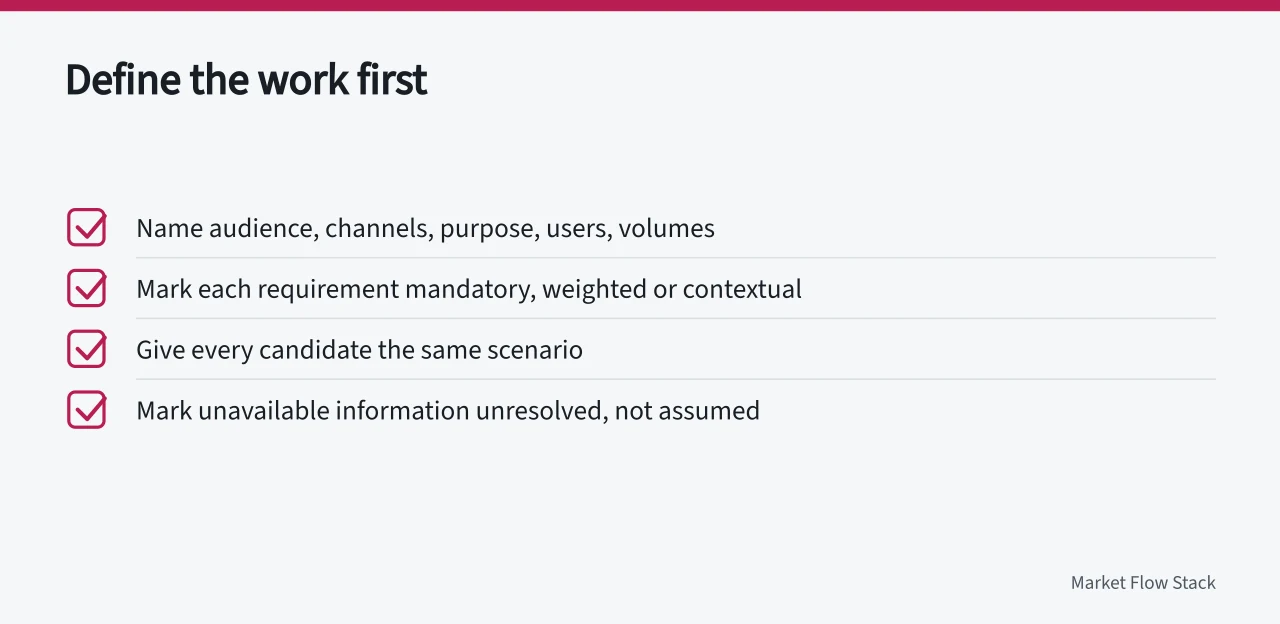
- The buyer has named the audience, channels, purpose, users, volumes, integrations, service hours and exit needs.
- Each requirement is mandatory, weighted or contextual before products are scored.
- Every candidate receives the same scenario, data description and expected outputs.
- Unavailable information is marked unresolved, not assumed present or absent.
For electronic mail, obtain qualified UK review against the ICO's guidance on direct marketing using electronic mail, published as channel guidance. The platform cannot create permission to contact a recipient.
Verify the supplier record
- Every named feature has a current first-party page or written supplier response with date and edition.
- Roadmap, preview and generally available functions are recorded separately.
- The proposed legal counterparty and company number match the quotation and contract.
- Directory membership, certification and observed delivery are separate evidence fields.
GOV.UK's company-information service (Get information about a company) helps locate filed records, but Companies House does not verify their accuracy. A filing cannot establish product quality or financial health.
Inspect data and controls
- The data map identifies controller, processor, subprocessors, locations, access and retention.
- Objections and suppressions can be reconciled across every destination.
- Privileged access, logs, alerts, backup and recovery have configured evidence.
- The buyer can export usable data and obtain deletion evidence at exit.
ICO processor-contract guidance (Contracts and liabilities between controllers and processors) supports the data-processing contract review. NCSC cloud security principles (The cloud security principles) support security questions. Neither source certifies a candidate.
Test the actual work
- The quoted edition is used for a controlled journey with approved test data.
- Ordinary, duplicate, missing, suppressed and failed-connector cases are preserved.
- A reviewer records input, configuration, expected output, actual output and defect.
- Relevant templates, forms and preference routes are tested against WCAG 2.2 with human review.
The reviewer reproduction step is the acceptance gate. A reviewer who did not configure the test must reproduce one mandatory result from the stored inputs.
Worked example: for suppression reconciliation, import a sample suppression list, run a journey that would target those addresses, and check the delivery log shows zero sends. Evidence is the imported list, the journey configuration and the log extract.
Contract and decide
- Currency, tax, period, usage units, services, support and renewal basis are comparable.
- Liability, change control, service levels, intellectual property and termination receive qualified review.
- Mandatory failures override any weighted total.
- The decision record states reviewer, conflicts, tests, gaps, expiry date and recheck triggers.
Reconcile defect status and confirm that the demonstrated edition matches the quotation. Preserve supplier responses beside the original questions so later readers can see what changed.
Create an exit rehearsal for one sample record and one configuration artefact. Confirm the available format, required skills, transfer route, receiving owner and deletion evidence. If the export can be produced but not interpreted or re-used, the exit requirement remains unresolved.
The decision minute should name the product, edition, contract entity, use case, evidence date and accepted exceptions. Give every exception an owner, expiry and stop condition. Reopen selection when a mandatory feature, price unit, subprocessor, data location, support route or buyer purpose changes.
Stop when a mandatory requirement fails or the evidence cannot be obtained within the decision window. Approve only the named product, edition, configuration, contract and use case that completed the process.
Common questions
What does a tick on this checklist actually mean?
A tick means the named evidence was inspected for the buyer's use case. It is not an endorsement, compliance finding or performance promise.
How should roadmap and preview functions be treated?
Treat them as separate from current features. Every named feature needs a dated first-party page or written supplier response. Directory membership, certification and observed delivery are separate evidence fields.
When should selection be reopened?
Reopen when a mandatory feature, price unit, subprocessor, data location, support route or buyer purpose changes. Stop if a mandatory requirement fails or evidence cannot be obtained within the decision window.