

Operations
Part of Marketing automation operations: four gates to review a platform
A marketing automation quality checklist covering audience logic, permissions and recovery
Use this marketing automation quality checklist in England to inspect audience logic, permissions, content, accessibility, recovery and evidence.
Use this marketing automation quality checklist at the release gate, not after the first complaint. It covers a journey's evidence, data path, message, controls and recovery. A tick records that evidence was inspected; it does not promise legal compliance or error-free delivery.
What to take away
- Use the checklist at the release gate, before complaints arrive, and treat each tick as inspected evidence only.
- Reconcile suppressions and objections across every source, platform and destination, because the objection right is absolute in direct marketing.
- Test branches with missing, late, duplicated and malformed values, and confirm failed writes create alerts and controlled retries.
- Reject the release if audience counts cannot be reconciled, objection handling fails or nobody can stop the journey.
- Review again after any change to purpose, audience, channel, supplier, data field or permission.
Method and scope
The checklist was assembled on 5 September 2026 from current UK regulator material, NCSC guidance and WCAG 2.2. It covers release-blocking defects in marketing journeys operating in England, but not supplier setup, channel-specific legal advice or performance optimisation. Sections are ordered by dependency.
Purpose, people and permission
- The release record names the purpose, accountable owner, audience, channel and operating period.
- A data owner can trace each entry field to its source and explain its meaning.
- A qualified reviewer has applied current UK GDPR and PECR analysis to the actual recipient and message.
- Suppressions and objections are reconciled across every source, platform and destination.
- The journey has an exit condition for people who no longer meet the audience rule.
The ICO's direct marketing guidance covers planning and preference handling. Its right-to-object guidance states that the objection right is absolute for use of personal information in direct marketing. The legal reviewer should verify how the current wording applies and how the stop reaches connected systems.
Purpose, people and permission
- Name purpose, owner, audience, channel, period
- Trace each entry field to its source
- Apply UK GDPR and PECR analysis
- Reconcile suppressions and objections everywhere
- Define exit for people outside audience
Worked example: A customer objects in the email platform. The CRM still holds a marketing consent flag, and the advertising audience sync uses it. The release record should show the objection mapped to the CRM's suppression field and removed from the ad audience. If the CRM cannot accept the stop, use a manual suppression queue before launch.
Logic and data behaviour
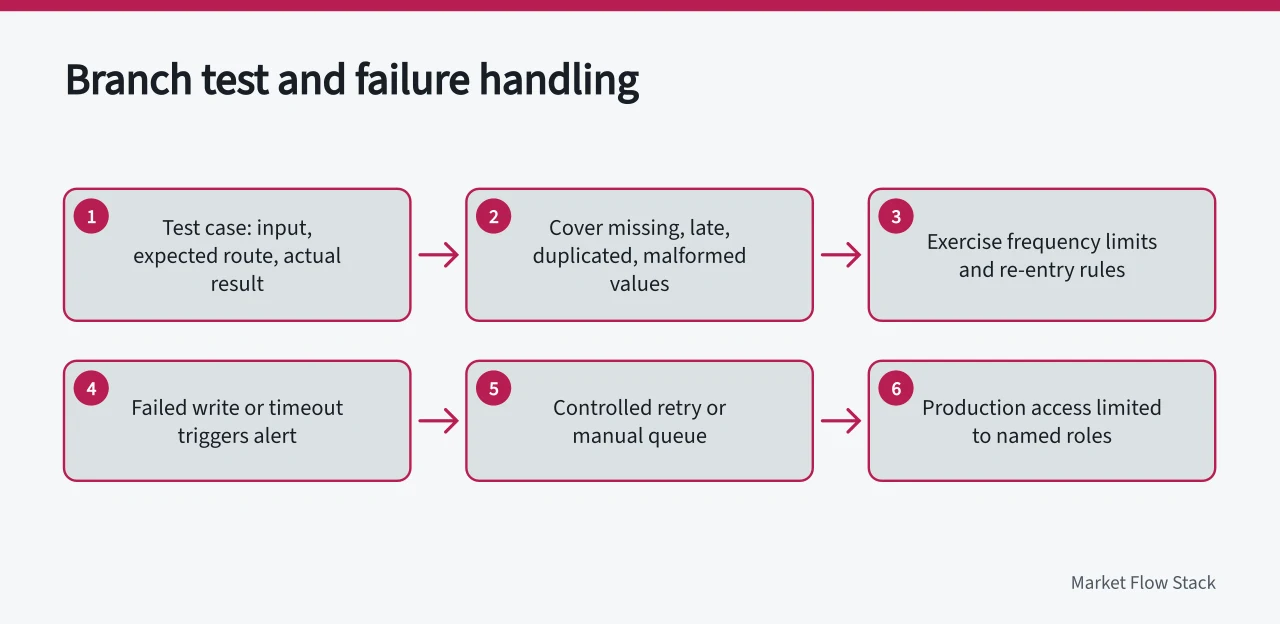
- Every branch has a test case with input, expected route, actual result, tester and timestamp.
- Tests cover missing, late, duplicated and malformed values, not just the ideal record.
- Frequency limits and re-entry rules have been exercised against realistic sequences.
- A failed write or connector timeout creates an alert and a controlled retry or manual queue.
- Production access is limited to named roles, and approval is recorded separately from configuration.
Use the NCSC cloud security principles to frame identity, privilege, audit and operational-security questions. Collect configuration evidence. A supplier statement alone does not show that the organisation's account uses the control correctly.
Content and accessible routes
- Sender identity, subject, visible message, fallback and destination match the approved version.
- Links resolve to the intended environment and preserve the approved tracking boundary.
- The preference or objection route works without trapping the user in the marketing flow.
- Keyboard use, focus, labels, contrast, error messages and responsive layout have human test evidence where relevant.
- Images have an approved text alternative or are correctly treated as decorative.
WCAG 2.2 supplies testable web-content criteria. It does not prove that an email client, authoring tool or edited template conforms. An accessibility specialist should choose the applicable scope and assistive-technology checks.
Release, recovery and sign-off
- The first-run observer, alert threshold, escalation route and pause authority are named.
- The team has tested the smallest safe pause and the master stop.
- Recovery instructions cover delayed, lost and duplicate events without automatic replay.
- Open exceptions state severity, owner, expiry date, compensating control and accepting authority.
- The final record contains version, approvals, evidence links and a review trigger.
Reject the release if audience counts cannot be reconciled, objection handling fails, a critical branch differs from expectation, an essential destination is inaccessible or nobody can stop the journey. Review again after any purpose, audience, channel, supplier, data-field or permission change.
For example, a missing date falls through the renewal branch to the default route and sends a win-back message. That mismatch blocks release until the branch is fixed.
Common questions
When should this checklist be used?
Run it before launch, not after a complaint. A tick confirms evidence was inspected; it is not a legal compliance certificate or a delivery guarantee.
What does the right to object mean for direct marketing?
ICO guidance treats the objection right as absolute for personal information used in direct marketing. Confirm the current wording and that a stop reaches every connected system. Reconcile objections across sources so a stop in one place is not ignored elsewhere.
What should trigger a release rejection?
Unreconciled audience counts, failed objection handling, a branch that departs from expectation, an inaccessible destination or no ability to stop the journey. A fresh review is needed after any change to purpose, audience, channel, supplier, data field or permission.