

Costs and pricing
Normalising marketing automation pricing before any supplier comparison means anything
Compare marketing automation pricing models in England by normalising supplier units, currency, tax, term, overage, services and exit scope.
Marketing automation pricing models in England are not directly comparable until the buyer fixes currency, tax, period, volumes and included work. A per-organisation price can still contain contact or message limits; a contact-based plan can still charge for seats, credits or onboarding.
What to take away
- Marketing automation prices are not comparable until the buyer normalises the commercial case.
- A per-organisation price can still hide contact or message limits and extra seat charges.
- Normalise every supplier to the same GBP scenario before comparing any bid.
- Keep onboarding, migration and support outside the licence row unless the contract includes them.
- Record the walk-away conditions before scoring any bid.
Comparison method
This desk comparison used public first-party pages checked on 5 September 2026. The common criteria are charging unit, currency, billing period, capacity boundary, visible add-ons and quotation gap. It excludes discounts, negotiated terms, implementation partners, exchange-rate forecasts and claims about value. Products are examples of models, listed alphabetically rather than ranked. No account or invoice was tested.
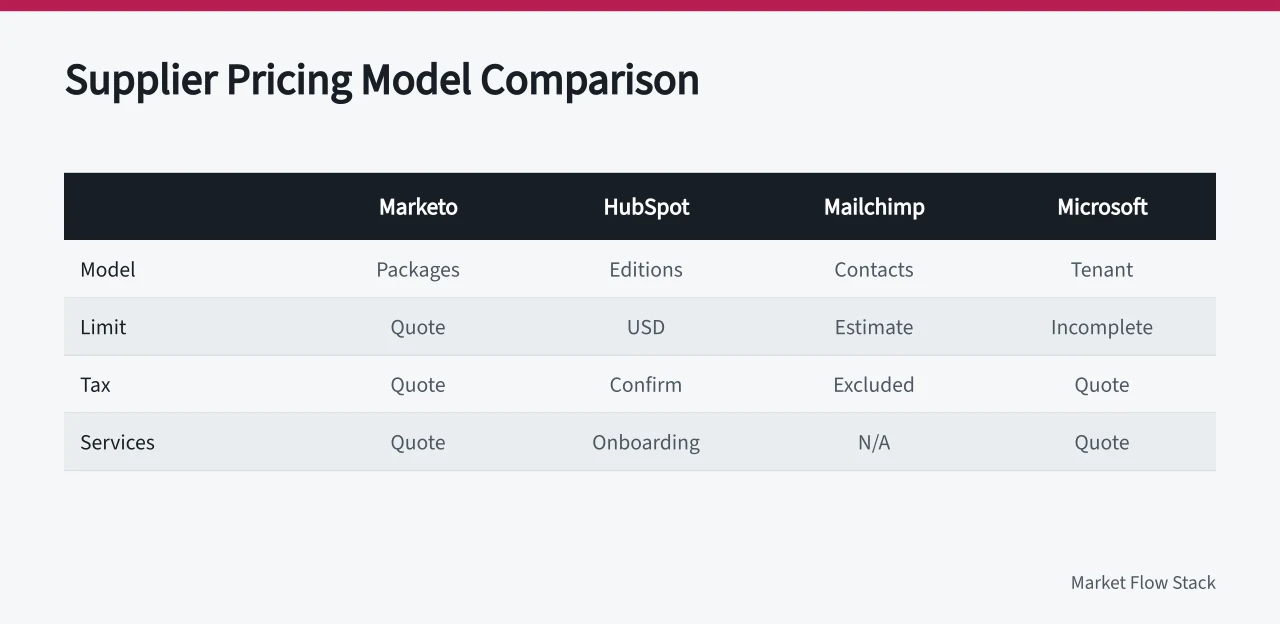
| Supplier record | Model visible on the page | Limit of the observation |
|---|---|---|
| Adobe Marketo Engage | Four packages with selected capacity differences and a route to request pricing | No public buyer-specific total; services and contract terms require a quote |
| HubSpot Marketing Hub | Edition structure with contacts, seats, credits and onboarding factors | Page displayed US dollars; UK billing and complete production scope need confirmation |
| Mailchimp marketing plans | Plans tied to contacts and send limits, with overage and feature differences | The GBP view says non-US dollar amounts are estimates and excludes applicable taxes and fees |
| Microsoft Customer Insights | Tenant price plus Unified People and Interacted People capacities, paid yearly | Qualifying licences, actual checkout price and external messaging need checking |
| Salesforce UK marketing editions | Named editions with organisation-level starting prices and annual billing | Detailed pricing, add-ons and availability require sales confirmation |
These are supplier statements, not independent price or suitability findings. A current written quote controls the purchase.
For the comparison model, use GBP per named contract period and supplier unit. Express every line as a rate per supplier unit, such as GBP per 1,000 contacts per month or GBP per 1,000 sends per month, and show the contract period.
Include all quoted and buyer-side work, exclude unapproved benefits, name finance as owner, cite quotes and plans, and test volume and currency sensitivities.
Normalise the commercial case
Give every supplier the same scenario: product and edition, users, clean contacts, marketable contacts, sends or interactions, environments, storage, integrations, support, AI or message units, contract start and evaluation period. Ask how duplicates, suppressed people, inactive records and failed interactions count. Enter every proposal in GBP on the same tax basis.
Worked GBP example for a mid-size UK buyer. Mailchimp's published GBP rate is £14 a month for 500 contacts, so a 50,000-contact requirement needs a quote. Assume the quote is £12,000 a year excluding VAT for 50,000 marketable contacts, 12 seats and 250,000 sends a month.
That is £1,000 a month, or £0.24 per marketable contact a year. UK VAT at 20% adds £2,400, so the gross cash cost is £14,400 a year.
Typical UK list-price benchmarks. Public contact-based plans typically start in the low tens of pounds a month and rise to the low hundreds of pounds a month at 50,000 contacts, before VAT.
Per-contact rates vary with volume: a plan at £14 a month for 500 contacts is £0.028 per contact a month. Suppliers often require a quote at higher volumes, so the written quote controls.
Normalise the Commercial Case
- Define same scenario for all suppliers
- Ask how duplicates and inactive count
- Enter proposals in GBP same tax basis
- Use row per price driver
- Separate services from licence row
- Treat VAT with approved method
- Check commitment and consumption
Use a row for each price driver rather than one converted total. Show quoted quantity, unit price, included allowance, expected quantity for the scenario, overage rule and evidence date. Put onboarding, migration, configuration, support and exit assistance outside the licence row unless the contract expressly includes them.
VAT needs an approved treatment. HMRC's business-expense guidance makes recovery conditional on registration, business use, evidence and other restrictions. Compare gross cash paid, recoverable VAT timing and net economic cost in separate columns.
Check commitment as well as consumption. A quoted allowance may be paid whether or not the organisation uses it, while an overage can create a different marginal rate above the boundary. Record minimum purchase, measurement interval, reset date, downgrade right and the evidence needed to dispute a count. This shows whether falling activity actually reduces cash cost.
Renewal belongs in the comparison case too. Preserve the initial and undiscounted renewal basis separately, including the notice deadline and any price-change mechanism. A temporary discount can affect early cash flow without changing the underlying unit economics.
Apply sensitivities and a walk-away rule
Recalculate each bid at current volume, a higher operating case and a stress case. These cases are not probability statements. Vary only one major driver at a time so the reviewer can see whether contacts, sends, currency, staff time or an add-on changes the result.
Do not score a proposal while an essential unit is undefined. Stop if the demonstrated edition differs from the quote, the tax or currency basis cannot be reconciled, a required add-on is unpriced, or exit help has no scope. Qualified accounting, tax and commercial reviewers should sign the normalisation before the comparison reaches an approval meeting.
Before you act
- Give every supplier the same written scenario.
- Record quoted quantity, unit price and overage rule.
- Separate gross cash, recoverable VAT and net cost.
- Test current, higher and stress volume cases.
Common questions
Why can a per-organisation price still be misleading?
The article says a per-organisation price can still contain contact or message limits, while a contact-based plan can still charge for seats, credits or onboarding. So the headline unit does not show the full cost. Buyers must check capacity boundaries, add-ons and the quotation gap before treating any figure as comparable.
What should a buyer do about VAT in the comparison?
VAT needs an approved treatment. HMRC guidance makes recovery conditional on registration, business use, evidence and other restrictions. The article says to compare gross cash paid, recoverable VAT timing and net economic cost in separate columns, rather than folding tax into one converted total.
When should a buyer stop scoring a proposal?
Stop if the demonstrated edition differs from the quote, the tax or currency basis cannot be reconciled, a required add-on is unpriced, or exit help has no scope. The article also says not to score a proposal while an essential unit is undefined, and qualified reviewers should sign the normalisation first.