

Tools and providers
Choosing marketing automation tools with the operating problem defined before the demo
Choose marketing automation tools and providers for 2027 using an England-focused evidence, testing, contract, security and exit process with confidence.
Choosing marketing automation tools and providers for 2027 should begin with a controlled business process, not a feature leaderboard. An England-based buyer needs to know which journeys are worth automating, what data may enter them, who can approve a send and how the organisation will leave the service. Only then can a product demonstration answer useful questions.
Research for this 2027 purchasing guide closed on 5 September 2026. It is desk research: no platform, connector, migration or support service was tested.
Supplier pages show what their publishers currently describe and sell, but do not prove fitness, compliance, accessibility, security or results for a particular organisation. Prices, editions and availability can change before a 2027 purchase. The final shortlist requires fresh written quotations and named qualified UK legal, data-protection, security, accessibility and commercial review.
What to take away
- Start with two or three owned journeys and hard exclusions before any product demonstration.
- Treat sales claims as an evidence ladder, ending in a controlled test with protected data.
- Normalise quotes across the same period, volumes and cost items before comparing suppliers.
- Keep legal, security and other assurance tracks separate rather than one broad score.
- Public supplier pages show propositions, not fitness, compliance, security or results.
- The five products here are Adobe Marketo Engage, HubSpot Marketing Hub, Mailchimp, Microsoft Dynamics 365 Customer Insights and Salesforce Marketing Cloud Next, listed alphabetically.
- Public pages publish a pricing unit rather than a bill, so a dated written quote is the only workable comparison.
- Take no more than three candidates into the scripted trial and decide on your own evidence.
Define the operating problem before viewing software
Start with two or three journeys that already have an owner and a defensible purpose. For each, record the trigger, recipient, channel, data inputs and decision rules. Then record content, approval point, suppression source, expected output and stopping event.
Define the Operating Problem
- Pick 2-3 owned journeys
- Record trigger, recipient, channel
- Record data inputs and decision rules
- Record content, approval, suppression
- Record expected output and stopping event
- Mark hard exclusions beside journeys
A useful requirement: within one working day of an eligible enquiry, create a task for the assigned sales owner. Send one approved email only where the channel rule permits it. A vague engagement goal is not testable.
Mark hard exclusions beside those journeys. These may include unsupported identity management, an inability to prevent unapproved publishing, no usable audit trail, inaccessible authoring, an undocumented export route or a contract that leaves deletion responsibilities unclear. A supplier that misses an exclusion should not reach a weighted score, however polished its demonstration.
England is the operating context, though much relevant law is UK-wide. Software permission is not legal permission. The ICO's electronic-mail guidance covers separate PECR questions for email, text and comparable stored messages.
The ICO's controller and processor contract guidance sets required processing terms, but does not settle the wider commercial bargain. Both pages need publication-day review, as relevant ICO material may change after the Data (Use and Access) Act 2025.
Build an evidence ladder
Do not give every sales statement equal weight. A practical evidence ladder has four levels:
Four-Level Evidence Ladder
- Level 1dated public product or pricing record
- Level 2written response tied to requirement
- Level 3buyer-controlled scripted demonstration
- Level 4time-limited test with rollback route
- a dated public product or pricing record, used only for the proposition it actually states;
- a written response tied to the buyer's requirement and proposed edition;
- a buyer-controlled demonstration using a scripted scenario;
- a time-limited test with representative but appropriately protected data, acceptance thresholds and a rollback route.
Capture gaps rather than filling them with assumptions. If a web page says that a product connects to other applications, it does not establish that the required object, direction, field, latency or error handling works. Ask the supplier to demonstrate the exact exchange, then make the buyer reproduce it without hidden administrator help.
The same discipline applies to artificial intelligence. Record the model or service involved, whether customer content is used for training, available human controls, logging, regional availability, consumption units and the behaviour when the feature is disabled. An announced capability is not a reason to place it in a production journey.
A dated discovery view of five products
The following products illustrate different starting points. They are listed alphabetically, not ranked or recommended. Inclusion required a live first-party automation record and a live first-party price, packaging or sales-contact boundary on the research date. Agencies and implementation partners are outside this product view.
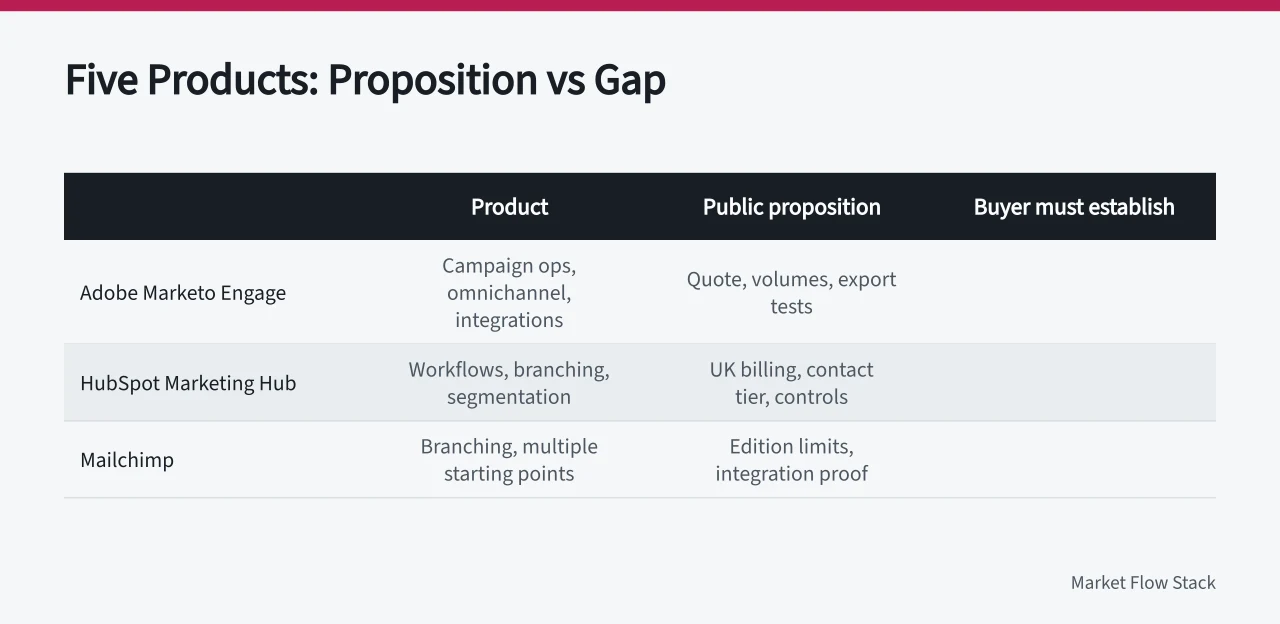
| Product | Publisher's current proposition | Commercial boundary visible on the public record | What a buyer still needs to establish |
|---|---|---|---|
| Adobe Marketo Engage | Adobe describes campaign operations, omnichannel engagement, audience work and integrations on its UK product page. | Adobe's UK packaging page shows four packages and directs buyers to request customised pricing. | Exact quote, volume assumptions, implementation effort, export tests and the contractual service boundary. |
| HubSpot Marketing Hub | HubSpot's automation page describes workflows, branching, segmentation and related Marketing Hub functions. | Its pricing comparison separates automation limits by edition, displays US dollar pricing and notes contact, credit, seat and onboarding factors. | UK billing terms, the intended contact tier, required integrations and edition-specific control tests. |
| Mailchimp | Mailchimp documents branching and multiple starting points in its marketing plan comparison. | The same GBP view shows plan, contact and send boundaries and warns that non-US dollar amounts are estimates affected by exchange rates, taxes and fees. | The final charged currency, audience calculation, overage exposure, permissions, exports and channel availability. |
| Microsoft Dynamics 365 Customer Insights | Microsoft's UK product record presents customer-data and journey-orchestration functions within the Dynamics environment. | The UK pricing page publishes tenant and capacity units, annual billing and VAT exclusions, while warning that checkout may differ. | Qualifying licences, capacity model, environment design, external messaging costs and integration behaviour. |
| Salesforce Marketing Cloud Next | Salesforce's UK editions page describes automated journeys and edition-specific marketing features. | It publishes organisation-level starting prices for named editions, identifies annual billing and directs buyers to sales for contract details. | Which product family is being quoted, add-ons, usage units, migration scope, administrator controls and exit assistance. |
The table is a route into discovery, not a complete market review. Five public sites cannot establish product quality or the range of suppliers serving England. Features can also sit behind particular editions, add-ons, consumption credits or regional releases. The buyer's requirements and controlled tests decide whether any entry remains relevant.
Editions and units named in public records
Each candidate publishes a pricing unit, not a bill. Taxes and fees sit outside headline figures, and Mailchimp marks non-dollar amounts as exchange-rate estimates. A dated quote in pounds is therefore the workable comparison. No vendor paid for a place in this view.
Editions and units
| Product | Editions named publicly | Unit and billing named on the page |
|---|---|---|
| Adobe Marketo Engage | Growth, Select, Prime, Ultimate | Quoted per package |
| HubSpot Marketing Hub | Free, Starter, Professional, Enterprise | Contacts, seats, credits |
| Mailchimp | Free, Essentials, Standard, Premium | Contacts and sends |
| Microsoft Dynamics 365 Customer Insights | Data and Journeys | Tenant, unified person, interacted person; annual payment; VAT treatment |
| Salesforce Marketing Cloud Next | Named UK editions | Organisation starting price; annual billing |
Recheck these names, units and boundaries on the decision date, because packaging and regional availability move. Request UK billing terms before any trial and model the contact tier you expect to run.
Ask Microsoft which component you need, then test profile counting, qualifying licences and failed interactions. For Salesforce, test the journey, administrator roles, add-on boundaries and the extraction route, and agree who owns consent data in the CRM.
Compare the full cost boundary
Licence headline costs are rarely decision-ready, so normalise each proposal to one period and scenario. Record currency, tax treatment, billing frequency, minimum term, renewal mechanism.
Normalise the Full Cost Boundary
- Record currency, tax, billing frequency, minimum term
- Record users, contacts, sends, interactions
- Record API calls, AI credits, support tier
- Keep discovery, migration, training visible
- Calculate current, credible and stress volumes
- Show undiscounted renewal case separately
Record users, marketable contacts, stored profiles, sends, interactions. Record environments, API calls, artificial intelligence or message credits, support tier, expected overage.
Keep one-off discovery, configuration, migration, integration, training visible, not buried in monthly totals. Keep assurance and exit work visible.
Calculate at least three volumes: the current clean dataset, a credible operating case and a stress case. Ask how suppression records, duplicates, inactive contacts and historical profiles count. The aim is not to predict a perfect 2027 bill. It is to expose which measurement can move the charge and which team will monitor it.
Treat discounts separately from the underlying model. A temporary offer can be recorded with its expiry and eligibility, but procurement should also show the undiscounted renewal case. Where a supplier provides only customised pricing, preserve the assumptions in the written quote so two bids can be compared on a common basis.
Keep six assurance tracks separate
One broad "compliance and security" score hides different decisions:
- Legal and privacy:map controller and processor roles, purposes, lawful bases, PECR channel decisions, transparency, retention, subprocessors and any restricted transfer. Counsel and the data-protection lead must review the actual data flow and terms.
- Security:test identity federation, multi-factor authentication, privileged roles, logs, incident information, recovery and change control. The NCSC cloud security principles provide a useful question set, not a supplier certificate.
- Accessibility:test authoring interfaces and representative outputs. WCAG 2.2 supplies technical success criteria, but a conformance badge or template claim does not replace testing with the organisation's content and assistive technologies.
- Integration:prove field mapping, authentication, rate limits, failure queues, retries, duplication behaviour and monitoring for each essential connection.
- Data portability:obtain sample exports for contacts, consent evidence, suppression data, content, workflow definitions, activity history and reports. Test whether another competent team can interpret them.
- Commercial terms:examine renewal, price changes, service commitments, liability, audit cooperation, suspension, change notification, termination assistance and deletion evidence.
Assign an owner and pass condition to each track. A privacy specialist should not be expected to approve penetration-test evidence, and a security lead should not interpret the PECR status of a recipient. The purchasing decision is the point where their separate conclusions meet.
Consent and the processor boundary
Each platform acts as a processor for the personal data a buyer loads into it. Consent, lawful basis, retention and deletion stay with the buyer.
A consent record the business cannot produce on request does not evidence consent.
PECR's soft opt-in covers existing customers only, so a bought list needs another lawful basis. The ICO's direct marketing guidance under PECR sets out the consent and soft opt-in tests.
Ask each vendor where data is hosted, which subprocessors are used, how long records are kept and how deletion is proved. Agree the deletion rule before any import, and record where the platform hosts and transfers personal data.
Run a buyer-controlled proof
Give shortlisted suppliers the same script. Use a small non-production dataset or approved synthetic records, with keyboard-only authoring and rendered-message checks.
Ask the buyer's own operator to build a journey, apply a suppression, change a permission and recover from a connector failure.
Export the resulting records and find relevant audit evidence, and record every supplier intervention, as assisted success may not reflect routine operation.
Acceptance thresholds should be observable. Examples include no send after a central opt-out reaches the test system, rejection of a user without publishing authority, an alert when a required integration fails and an export that retains identifiers needed for reconciliation. These are test designs, not claims that any product will pass.
Stop the exercise if protected data appears outside the approved boundary, a required control cannot be demonstrated, material costs remain undefined or the supplier substitutes a different edition from the one quoted. A failed test can be more valuable than a persuasive presentation because it prevents an unsuitable commitment.
Decide with an exit already designed
Score only evidence available for the proposed configuration. Keep hard exclusions outside the arithmetic, cap scores where evidence is merely a supplier assertion and document who accepted each residual risk. The decision note should include rejected options and reasons, not just the chosen platform.
Before signature, rehearse departure on paper, then list notice dates, export formats, technical dependencies, supplier help and internal owners. Add parallel-running needs, deletion evidence and where suppression records live after exit.
The ICO's contract guidance requires processor terms to cover returning or deleting personal information at the controller's choice when services end, unless law requires storage. That regulatory requirement does not answer every practical migration question, so the commercial schedule must do more.
For 2027, the sensible next step is a requirements workshop, not a sales call. Select two journeys, document exclusions, assign the six assurance owners and issue one evidence request to every candidate.
Freeze the articles and quotations used in the decision. Recheck supplier pages, ICO guidance, price units and contractual terms immediately before approval.
Publication of this guide also remains on hold until the named specialists have completed their reviews.
Before you act
- Define the operating problem and record each journey's trigger, rules and stopping event.
- Mark hard exclusions and reject suppliers that miss them.
- Ask suppliers to demonstrate the exact data exchange, then reproduce it unaided.
- Record AI model, training use, controls, logging and behaviour when disabled.
- Calculate current, credible and stress volumes, including suppression and duplicates.
- Keep one-off discovery, migration, training and exit costs visible.
- Request a dated quote in pounds, with taxes and fees shown separately.
- Record the edition, the contact tier and any credit or interaction unit.
- Run one scripted trial journey that includes a role change and a failed event.
- Export the full list and reconcile counts, suppression and timestamps against your own records.
- Put the exit rehearsal and the exit date in writing before signature.
Common questions
Why should a buyer define the operating problem before seeing a demo?
The article says choosing tools should begin with a controlled business process, not a feature leaderboard. A buyer must know which journeys are worth automating, what data may enter them, who approves a send and how the organisation will leave the service. Only then can a demonstration answer useful questions.
What does the evidence ladder mean in practice?
It means not giving every sales statement equal weight. The four levels are a dated public product or pricing record, a written response tied to the buyer's requirement, a buyer-controlled scripted demonstration and a time-limited test with protected data, acceptance thresholds and a rollback route.
How should a buyer compare costs across suppliers?
Normalise each proposal over the same period and scenario. Record currency, tax, billing frequency, minimum term, renewal, users, contacts, sends, interactions, environments, API calls, credits, support and expected overage. Calculate current, credible and stress volumes, and keep one-off discovery, migration, training and exit work visible.
Why is there no ranking?
A ranking would need tested performance and comparable commercial terms. Neither appears on the public pages reviewed here, so the five entries run alphabetically.
In this guide
- Marketing automation software selection: review methodA platform-review method for marketing automation software selection using hard exclusions, edition-specific evidence and controlled trials.
- Marketing automation supplier comparison: a ready-to-run operator test scriptA ready-to-run script for comparing marketing automation suppliers such as HubSpot, ActiveCampaign, Brevo, Dotdigital and Klaviyo: test data, steps, expected outcomes and a scoring log.
- Marketing automation vendor due diligence, from corporate identity to exit evidenceUse this marketing automation vendor due diligence checklist to test legal roles, security, accessibility, integration, pricing and exit evidence.